
AP Chemistry Unit 1 – Atomic Structure and Properties

Table of Content
AP Chemistry Unit 1: Review
The eight topics in AP Chemistry Unit 1 can be grouped into three sections, which will help you remember how they relate:
| Section | Topics | What you learn |
|---|---|---|
| 1. Counting and identifying matter | 1.1 Moles and Molar Mass 1.2 Mass Spectra of Elements 1.3 Elemental Composition of Pure Substances 1.4 Composition of Mixtures | How to count particles and work out what a sample is made of |
| 2. How electrons are arranged in atoms | 1.5 Atomic Structure and Electron Configuration 1.6 Photoelectron Spectroscopy | Where electrons sit in an atom, and how PES measures the energy of electrons in each subshell |
| 3. How that arrangement explains the periodic table | 1.7 Periodic Trends 1.8 Valence Electrons and Ionic Compounds | Why properties change across the table and how atoms form ions |
1.1 Moles and Molar Mass
A mole is a counting unit. One mole contains 6.022 × 10²³ particles.
Molar mass connects the mass of a substance in grams to the amount in moles. For example, water has a molar mass of about 18.0 grams per mole:
| moles = mass ÷ molar mass |
This is also written as n = m/M.
To go from moles to particles, multiply by Avogadro’s constant. To go from particles to moles, divide by it. Always name the kind of particle you are counting: atoms, molecules, or formula units.
Example: How many molecules of water (H₂O) are in a 36.0 g sample if its molar mass is 18.0 g/mol?
- 36.0 g ÷ 18.0 g/mol = 2.00 mol H₂O
- 2.00 mol × 6.022 × 10²³ molecules/mol = 1.204 × 10²⁴ water molecules
Water is made of molecules. An ionic substance such as sodium chloride is counted in formula units, while a sample of iron is counted in atoms.
Example question: How many Na⁺ ions and how many Cl⁻ ions are in 1.00 mol of NaCl?
1.00 mol of NaCl contains 6.022 × 10²³ Na⁺ ions and 6.022 × 10²³ Cl⁻ ions.
1.2 Mass Spectra of Elements
Atoms of the same element have the same number of protons. They can have different numbers of neutrons, which gives them different masses. These forms of an element are called isotopes.
A mass spectrum displays the isotopes in a sample of one element.
- The peak position shows an isotope’s mass, and the peak height shows its relative abundance.
- The average atomic mass is a weighted average: an isotope that is more abundant contributes more to the average.
Example: Calculating an Element’s Average Atomic Mass from Its Isotopes
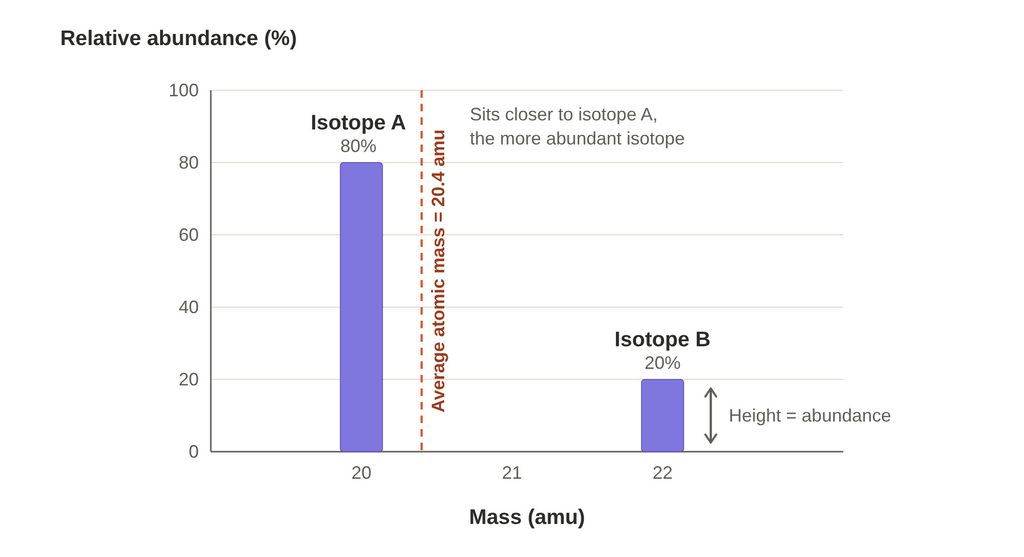
- Isotope A has a mass of 20 amu and an abundance of 80%.
- Isotope B has a mass of 22 amu and an abundance of 20%.
Convert the percentages to decimals and calculate:
(20 × 0.80) + (22 × 0.20) = 20.4 amu
The average atomic mass is 20.4 amu. It does not have to equal either isotope’s mass; it is closer to the mass of the more abundant isotope.
Check yourself: On a mass spectrum, what does a taller peak tell you? Why might the average atomic mass be closer to one isotope’s mass than another’s?
1.3 Elemental Composition of Pure Substances
A pure compound has a fixed ratio of elements. Its empirical formula gives the simplest whole-number ratio of the atoms in the compound. You can use a compound’s percent composition by mass to work out that ratio.
Example: A compound is 40.0% carbon, 6.7% hydrogen, and 53.3% oxygen by mass. Imagine you have a 100 g sample. That gives you:
- 40.0 g carbon
- 6.7 g hydrogen
- 53.3 g oxygen
Convert each mass to moles:
- Carbon: 40.0 ÷ 12.01 ≈ 3.33 mol
- Hydrogen: 6.7 ÷ 1.008 ≈ 6.65 mol
- Oxygen: 53.3 ÷ 16.00 ≈ 3.33 mol
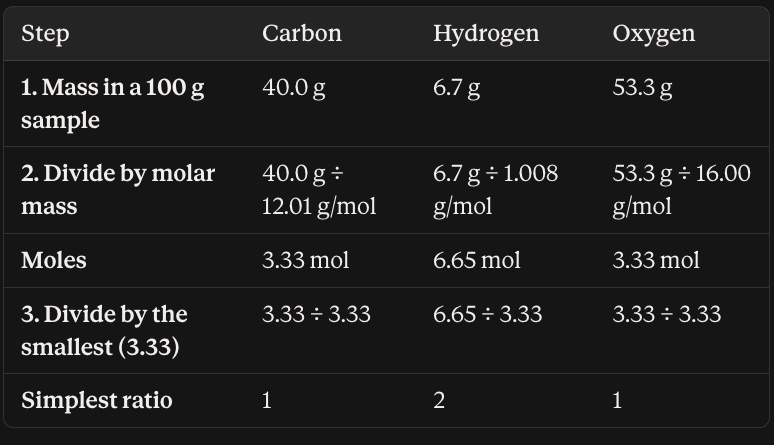
Divide each amount by the smallest value, 3.33. The ratio is about 1:2:1, so the empirical formula is CH₂O.
The empirical formula describes the simplest ratio. It may not tell you the actual number of atoms in a molecule; for that, you would need additional information.
Check yourself: If you know the mass of each element in a sample, what is the first step toward finding its empirical formula? Why do you convert grams to moles?
Continue with Viziscience: [Add a link to the lesson or practice for percent composition and empirical formulas.]
1.4 Composition of Mixtures
A pure substance contains one type of particle. A mixture contains two or more types of particles, and the proportions can vary from one sample to another.
That difference matters when you analyze a sample.
- A pure compound has a consistent composition.
- A mixture may contain different amounts of its components.
- Measuring the sample’s mass or elemental composition can help you determine what is present, how much of each substance is present, or whether the sample may contain an impurity.
Example question: A 50 g mixture contains 20 g of substance A and 30 g of substance B. What is the percent by mass of each substance in the mixture?
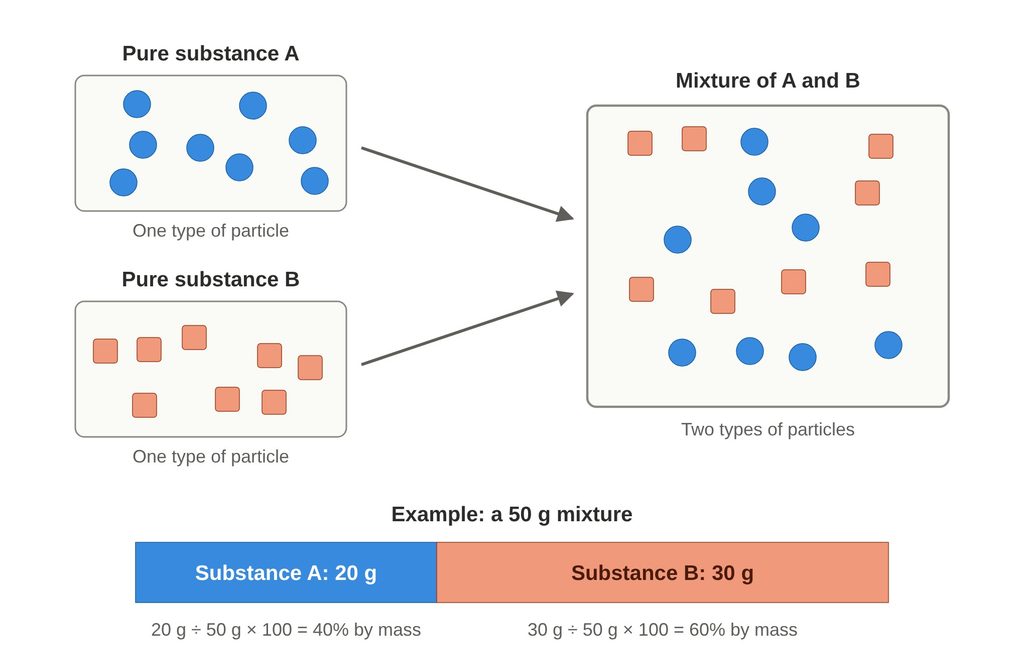
- Substance A = 40% by mass
- Substance B = 60% by mass
The mixture’s proportions could change in another sample. The fixed elemental proportions of a pure compound would not change from sample to sample.
Check yourself: A sample contains two kinds of particles in different amounts. Is it a pure substance or a mixture? What kind of measurement could help you estimate the amounts?
1.5 Atomic Structure and Electron Configuration
An atom has a small, positively charged nucleus containing protons and neutrons. Negatively charged electrons occupy regions around the nucleus, described in shells and subshells.
An electron configuration shows how the electrons are arranged. The Aufbau principle is the pattern used to place electrons into lower-energy orbitals before higher-energy ones. Electrons in the inner levels are called core electrons. The outer electrons are called valence electrons.
An atom becomes an ion when it gains or loses electrons. Its number of protons stays the same; its number of electrons changes.
Finding Electron Configuration
Example: Write the electron configuration of a neutral magnesium atom (Mg).
Use the periodic table above, locate Mg on the periodic table.
| To reach Mg: – Pass the whole 1s block: 2 positions → 1s² – Pass the whole 2s block: 2 positions → 2s² – Pass the whole 2p block: 6 positions → 2p⁶ – Stop at Mg, the second position in 3s → 3s² Mg: 1s² 2s² 2p⁶ 3s² |
A magnesium ion with a 2+ charge has lost two electrons:
| Mg²⁺: 1s² 2s² 2p⁶ The outer 3s electrons were removed. |
Ionization Energy
Electron configurations also help explain ionization energy: the energy needed to remove an electron. An electron that is farther from the nucleus, or more shielded by other electrons, is generally easier to remove. An electron held more strongly by the nucleus takes more energy to remove. The CED asks you to reason about these relationships qualitatively.
Check yourself: How many electrons does Mg²⁺ have? Which electrons are the core electrons in a magnesium atom? Why does an electron closer to the nucleus generally take more energy to remove?
CED scope: The AP Chemistry CED requires electron configurations using the Aufbau principle. It excludes assigning quantum numbers and writing configurations for elements that are exceptions to Aufbau.
1.6 Photoelectron Spectroscopy
Photoelectron spectroscopy, usually shortened to PES, measures how much energy it takes to remove electrons from an atom or ion.
A PES graph gives you evidence about an atom’s electron configuration:
- Each peak represents electrons in a subshell.
- A peak’s position relates to the energy needed to remove those electrons.
- A peak’s relative height relates to the number of electrons in that subshell.
Read the labels and scale on the graph carefully. The direction of increasing energy depends on how the graph is drawn.
Example: Magnesium has the electron configuration 1s² 2s² 2p⁶ 3s². Its PES data should show subshells containing 2, 2, 6, and 2 electrons. The peak heights reflect those relative numbers. Peak positions show that the different groups of electrons are held with different strengths.
A good explanation connects the graph to the electron configuration and to the attraction between electrons and the nucleus.
Check yourself: If one PES peak is taller than another, what can you infer? If a peak represents electrons that need more energy to remove, what does that suggest about how strongly they are attracted to the nucleus?
1.7 Periodic Trends
The periodic table is organized so that properties repeat in patterns. Those patterns are connected to electron configurations and the way the nucleus attracts electrons.
The CED names these atomic properties:
- Atomic radius: the size of a neutral atom
- Ionic radius: the size of an ion
- Ionization energy: the energy needed to remove an electron
- Electron affinity: the energy change when an atom gains an electron
- Electronegativity: how strongly an atom attracts shared electrons in a bond
Across a period from left to right, the number of protons increases while added electrons enter the same general shell. The stronger effective nuclear attraction usually pulls the electrons closer. Atomic radius generally decreases, while ionization energy and electronegativity generally increase.
Down a group, atoms gain additional electron shells. The outer electrons are farther from the nucleus and are shielded by more inner electrons. Atomic radius generally increases, and ionization energy and electronegativity generally decrease.
Some properties, especially electron affinity, have more exceptions to a simple arrow rule. Use the data provided when it is available, and explain trends through shell level, shielding, and effective nuclear charge.
Ions also have different sizes from their neutral atoms. A positive ion, or cation, is usually smaller than its neutral atom; a negative ion, or anion, is usually larger. If ions have the same number of electrons, the one with more protons is generally smaller because its nucleus pulls on those electrons more strongly.
Check yourself: Which is generally larger, a neutral atom or its cation? How would adding an electron shell affect an atom’s size? What does a stronger effective nuclear charge do to the attraction between the nucleus and the electrons?
1.8 Valence Electrons and Ionic Compounds
Valence electrons are the outer electrons involved in bonding. Their interactions with the nuclei of atoms help determine whether elements form bonds and how they react.
Elements in the same column, or group, of the periodic table often have similar valence-electron arrangements. That is why they often form similar compounds and show related chemical behavior.
The position of a main-group element can also help you predict its typical charge in an ionic compound. For example:
- Group 1 elements commonly form +1 ions.
- Group 2 elements commonly form +2 ions.
- Group 17 elements commonly form −1 ions.
- Group 16 elements commonly form −2 ions.
These are common patterns, not a rule that every element must follow in every compound. Some elements can form ions with different charges.
Check yourself: How many valence electrons does a Group 1 element have? What charge does it commonly form as an ion? Why do elements in the same group often have similar chemical behavior?
A useful connection: successive ionization energies
Successive ionization energies are the energies needed to remove electrons one at a time from the same atom. The first electrons removed are outer electrons. After those are gone, removing the next electron means taking one from a more tightly held inner shell.
A very large jump in the data signals that change. Count how many electrons were removed before the jump: for the atom represented, that number tells you how many outer electrons were removed before reaching the inner shell.
Example: If the large jump occurs after the second electron is removed, the atom had two outer electrons before removal reached the inner shell.
This is a useful application of the CED’s ideas about electron shells and ionization energy in Topic 1.5. It is not a separate numbered Unit 1 learning objective.
AP Chemistry Unit 1 Skills
By the end of this unit, you should be able to:
- Convert between grams, moles, and particles, using the right particle type and showing units.
- Read isotope and PES graphs and use the information in them.
- Use composition data to calculate empirical formulas or analyze mixtures.
- Represent the electron configuration of an atom or ion.
- Explain periodic patterns using electron structure and attraction to the nucleus.
- Use valence electrons and periodic-table position to explain typical ion charges and related chemical behavior.
If one of these still feels difficult, use the linked lesson and practice for that specific topic. You do not have to guess where to begin: use the AP Chemistry Unit 1 mastery checklist to identify the skill you need to work on.
This page is a student-friendly paraphrase of the College Board AP Chemistry Course and Exam Description, AP Chemistry Unit 1 Required Course Content. For the official wording and scope, see the AP Chemistry Course and Exam Description. Viziscience is an independent learning resource and is not affiliated with or endorsed by the College Board.
Summary
This AP Chemistry Unit 1 review covers moles and composition, atomic structure and electron configuration, and periodic trends and ionic compounds. It explains the unit’s key ideas with clear examples and shows how the topics connect, from converting between grams and moles to using electron structure to explain periodic patterns and ion charges.
